
Egg Facts
Two at Once: The Rare Biology and Quiet Folklore of the Double-Yolk Egg
A kitchen surprise with a story older than modern henhouses
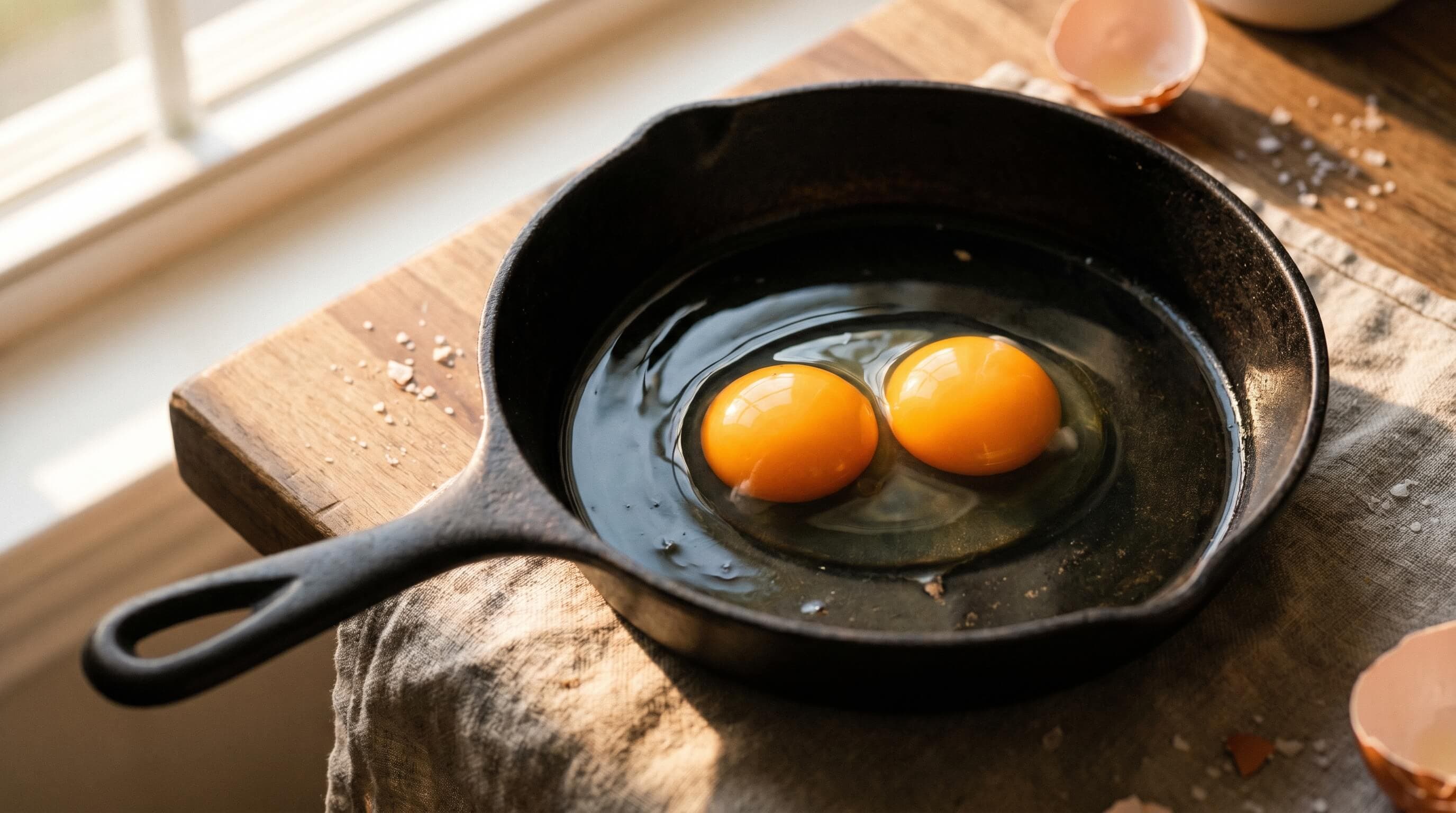
There is a particular kind of luck involved in cracking an egg open and finding two yolks pooling together in the pan. It happens without warning - a small gift from a hen who had an unusual morning. Most people photograph it. Some consider it an omen. A few look it up immediately. Almost nobody fully understands what they are looking at.
The double-yolk egg is not a mutation or a deformity. It is the result of a specific reproductive event called hyperovulation - the release of two yolks from a hen's ovary in such rapid succession that they travel down the oviduct together, becoming encased in a single membrane and a single shell. The process that normally governs this release, a finely tuned hormonal rhythm, briefly misfires, and two yolks begin their 24-hour journey through the reproductive tract simultaneously.
Young Hens and Hormonal Rhythms
Double-yolk eggs occur most frequently in pullets - hens in the first few months of their laying life, typically between 18 and 30 weeks of age. At this stage, the hormonal feedback loop governing ovulation has not yet established a consistent cadence. The pituitary gland releases luteinizing hormone in pulses that can occasionally trigger two follicles to mature and release within hours of each other, rather than the standard 24-to-26-hour interval. As the hen's cycle matures and regulates, the frequency of double-yolk eggs drops sharply.
Certain breeds are statistically more prone to it. Larger, heavier laying breeds - such as Rhode Island Reds and some commercial hybrid layers selected for high output - produce double yolks at slightly higher rates than smaller or heritage breeds. High-production genetics, which push hens toward accelerated laying cycles, appear to correlate with occasional ovulation overlap.
How Rare Is Rare?
The commonly cited figure is roughly one in every 1,000 eggs. But that probability is not uniform across a carton. At commercial scale, egg farms run every egg under a candling light - a bright backlit inspection that reveals the silhouette of the yolks inside. Double-yolk eggs are visibly larger and slightly longer than standard eggs, and their increased mass often places them in the jumbo size category. Many large operations sort them out entirely, packaging them into specialty cartons sold at a premium, or routing them to food service accounts.
This means that if you crack a double-yolk egg from a standard supermarket carton, you are looking at one that slipped through sorting - a genuine statistical outlier. If you buy from a small farm or a farmers market, especially one that does not candle or sort aggressively, your odds improve considerably. Some small-scale producers actively market them as a feature rather than an anomaly.
The Weight of Superstition
The double-yolk egg carries more symbolic freight than any other culinary accident. In parts of England and Northern Europe, cracking one open was historically read as a sign that twins were imminent in the household - either a pregnancy already underway or one soon to arrive. In Norwegian and Swedish folk tradition it was considered broadly lucky, a sign of abundance from the land. Some Ukrainian households, according to food historian Olia Hercules, treated double-yolk eggs as too precious to eat casually, reserving them for feast days or special baking.
The twin symbolism runs deeper than coincidence. Before modern obstetrics, twin births were genuinely unexpected, and the egg - already a powerful symbol of fertility and new life across nearly every human culture - offered a kind of forewarning in its doubled state. That a single shell could contain two complete structures seemed, to preindustrial minds, like the universe flagging something extraordinary.
In some parts of East Africa and the Caribbean, the double-yolk egg was interpreted differently - not as luck but as an omen demanding caution, something to be handled with awareness rather than celebrated. The symbolism shifted depending on the local relationship between abundance and risk.
The Baker's Dilemma
In professional kitchens, particularly in pastry, double-yolk eggs create a measurement problem. A standard large egg contributes approximately 30 grams of yolk to a recipe. A double-yolk egg from the same carton may deliver 45 to 55 grams. In recipes where yolk-to-white ratio is critical - lemon curd, hollandaise, financiers, certain custards - this discrepancy is significant enough to affect texture, set, and flavor.
Most pastry chefs at serious operations specify eggs by weight rather than count precisely to avoid this variability. If you are scaling a delicate recipe at home and crack open a double, it is worth pausing: you now have more yolk than the formula expects, and in an emulsion or a set custard, that matters more than it might appear.
Outside of precision pastry, the double-yolk egg is simply richer, more voluminous, and more satisfying to eat. Fried or soft-scrambled, it produces a deeper pool of golden fat that, in a dish where yolk is the point, is entirely welcome. Soft-boiled, it behaves differently from what you might expect - the two yolks often do not set at identical rates, producing an interior with distinct regions of doneness that can, depending on your preference, be either charming or disorienting.
A Shell That Had to Work Harder
The shell of a double-yolk egg tells its own story. Because the total volume inside the shell is greater, the hen's shell gland - which deposits calcium carbonate around the egg over a 20-hour period - must stretch to accommodate more interior mass. The result is often a shell that appears slightly thinner relative to its volume, and sometimes visibly elongated compared to a standard egg of the same grade. Shells on double-yolk eggs can be more susceptible to cracking under pressure that a single-yolk egg would withstand without issue - worth knowing before you add them to a pot of boiling water.
The albumen is also different in proportion. Because two yolks occupy more of the shell's interior, the thick albumen layer surrounding each yolk may be compressed, producing whites that are slightly looser and less defined when poached or fried in an open pan. For applications where white structure carries the dish, this is worth accounting for in advance.
A Rarity Worth Pausing For
In an era when egg production is almost entirely industrialized and standardized, the double-yolk egg remains genuinely uncontrolled - a product of biology operating on its own schedule, slipping past sorting mechanisms and landing in an ordinary carton. It is one of the few moments in modern food where something unexpected still happens at the breakfast table.
Whether you read it as luck, treat it as a baker's variable, or simply enjoy the extra richness in the pan, it deserves at least a moment of recognition. The hen responsible was, most likely, a young bird still working out the timing. In that sense, the double yolk is less a miracle than a mark of a creature still finding its rhythm - which, depending on your morning, might be the most relatable thing in the kitchen.