
Egg Facts
Washed Away: The Invisible Coating That Divides the Egg World in Two
A microscopic layer of protein, deposited in the final hour of shell formation, sits at the center of one of food safety's most quietly contentious debates
Walk into a grocery store in Lyon, Rome, or Amsterdam and you will find eggs sitting on an unrefrigerated shelf, stacked at room temperature beside dried pasta and canned tomatoes. Walk into a grocery store in Chicago, Toronto, or Sydney and those same eggs are in a refrigerated case, treated with the same urgency as raw meat. The egg has not changed. The difference, invisible to the naked eye, was removed during processing - and its absence is what forces the cold chain.
That difference is called the bloom, or more precisely, the cuticle. It is one of the most elegant biological structures in the avian world, and the fact that half the globe routinely destroys it before the egg ever reaches a consumer is either a triumph of industrial food safety or an unnecessary intervention, depending on which regulatory body you ask.
Twenty-Six Hours, Seven Thousand Pores
A hen requires approximately 26 hours to produce a single egg. The yolk forms first, released from the ovary and traveling through the oviduct, where it accumulates albumen, then membrane layers, then shell. The shell itself - composed almost entirely of calcium carbonate crystals arranged in a lattice around a protein matrix - takes roughly 20 of those 26 hours to calcify in the uterus.
In the final 90 minutes before lay, something quieter happens. The shell is coated in a thin organic layer, between 10 and 30 micrometers thick, made primarily of protein and glycoprotein. This is the cuticle. Under a scanning electron microscope, it appears as a translucent film draped over the crystalline shell surface, sealing somewhere between 7,000 and 17,000 microscopic pores that perforate every eggshell.
Those pores are not a design flaw. They exist to allow gas exchange - the developing embryo inside a fertilized egg breathes through them. In an unfertilized egg, they remain: open channels between the interior of the egg and the external environment. The cuticle reduces, though does not eliminate, the rate at which bacteria, moisture, and odors can pass through the shell. It also slows the natural loss of carbon dioxide and water vapor from the egg's interior - the two primary mechanisms by which a fresh egg becomes a stale one.
The Regulatory Schism
The United States Department of Agriculture mandates that commercially sold eggs be washed and sanitized before reaching the market. The reasoning is straightforward: Salmonella contamination on the shell surface is a genuine food safety concern, and washing - using warm water and detergent at a temperature at least 10°C warmer than the egg - kills surface bacteria. The regulation was codified in the 1970s following outbreaks linked to contaminated shell surfaces.
The consequence is that the bloom is removed in the process. A washed egg, stripped of its cuticle, now has thousands of open pores and no natural barrier against bacterial penetration. The cold chain - continuous refrigeration from processing facility to consumer refrigerator - becomes mandatory, not optional. A washed egg left at room temperature will begin accumulating bacteria on and through its shell within hours.
The European Union takes the opposite position. EU regulations prohibit the washing of eggs intended for retail sale, reasoning that washing gives a false impression of safety while removing the egg's natural defense and creating dependency on an unbroken cold chain. The logic is that an unwashed egg with its cuticle intact is safer at ambient temperatures than a washed egg that has been compromised and then improperly handled. Eggs in the EU are instead graded, and the grading system - Class A, sold fresh; Class B, processed industrially - is built around the assumption that the cuticle remains intact.
Australia, Canada, and Japan broadly follow the US model. The UK, despite Brexit, retained EU-aligned rules. The result is that the egg - one of the most globally traded food commodities - is handled according to two entirely incompatible philosophies, each internally consistent and each producing eggs that are, statistically, safe to eat.
Before the Refrigerator
The cuticle debate is recent. The methods humans used to preserve eggs before mechanical refrigeration are considerably older and considerably more inventive, and most of them worked by addressing exactly the same problem the cuticle solves: keeping air out.
Water glassing - submerging eggs in a solution of sodium silicate and water - was common in North America and Europe from the mid-19th century through the Second World War. The silicate solution penetrated the pores and effectively mineralized them, sealing the shell. Eggs stored this way could remain edible for up to a year. The technique fell out of use not because it stopped working, but because refrigeration became cheap enough that it was no longer necessary.
Liming - immersing eggs in a slaked lime solution - operated on the same principle, creating an alkaline environment hostile to bacteria while physically sealing the shell. Rural households across Britain and the American South routinely preserved autumn's surplus eggs this way for winter consumption through the 19th and early 20th centuries.
In China, a more radical preservation strategy evolved over roughly a millennium into what is now known as the century egg or pidan. Eggs packed in a clay mixture of ash, salt, quicklime, and rice hulls undergo a slow alkaline transformation over several weeks to months - the albumen sets into a translucent dark gel, the yolk becomes a creamy grey-green center, and the flavor intensifies into something deeply savory, sulfurous, and complex. The process is not preservation in the sense of halting change; it is controlled transformation. The result is chemically stable enough to require no refrigeration at all.
In France, the traditional method was simpler: coat the unwashed egg in a thin layer of fat - lard, goose fat, or later mineral oil - and store in a cool cellar. The fat blocked the pores. The principle was identical to the cuticle's function. It was the cuticle, replicated manually.
What the Shell Tells You
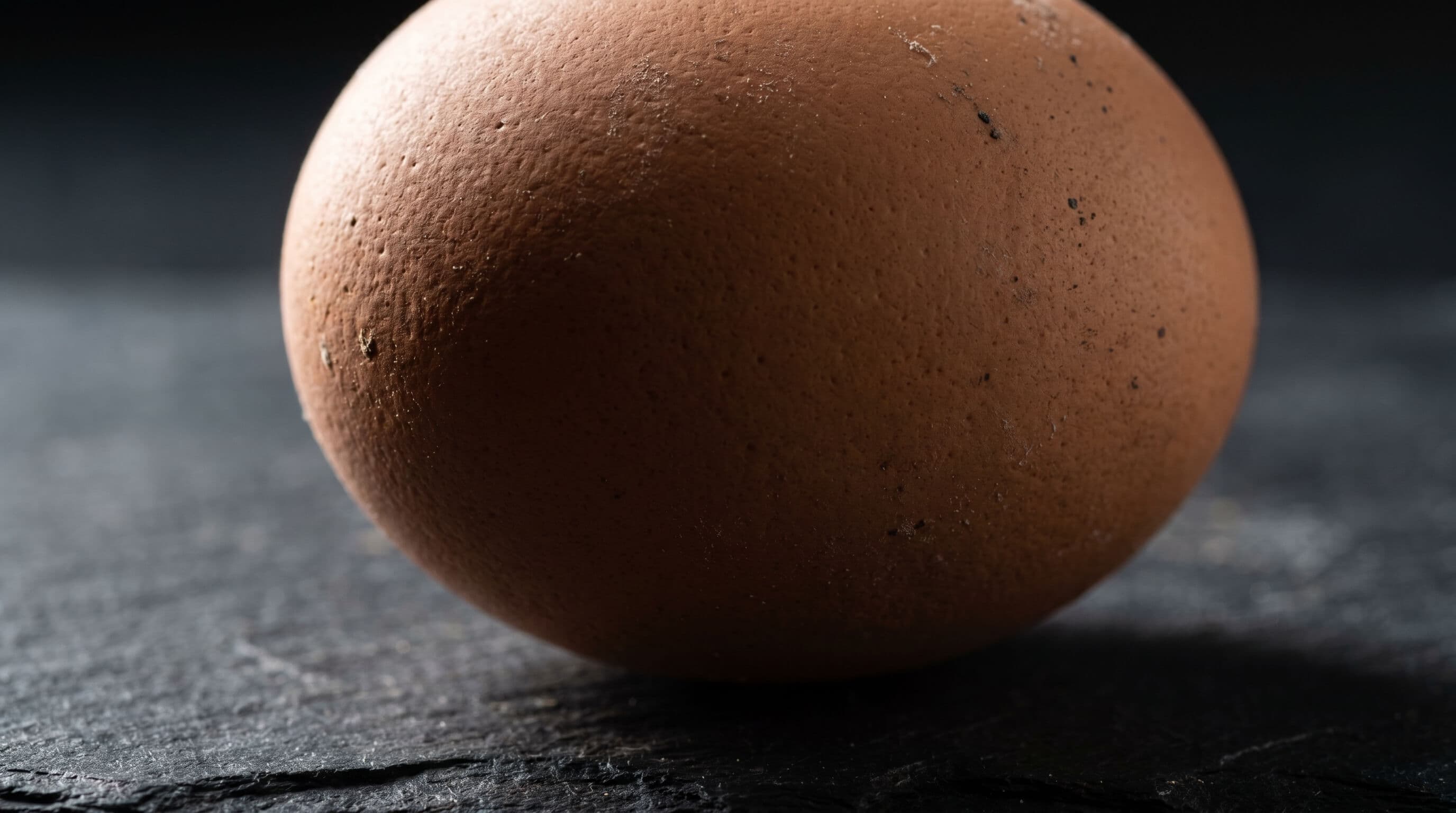
Beyond the cuticle, the shell itself carries information that most consumers never read. A fresh egg has a slightly rough, matte texture - the cuticle contributes to this. As an egg ages and the cuticle degrades, the shell often becomes shinier. Eggs that have been improperly handled or stored frequently show a slightly iridescent surface sheen: the calcium carbonate crystals, no longer covered, catch light differently.
The color of the shell - white, brown, speckled, blue-green in the case of Araucana and Ameraucana breeds - is determined entirely by genetics, specifically by which pigments the hen deposits during shell formation. Brown shells acquire their color from protoporphyrin IX, a compound derived from hemoglobin breakdown, applied as a paint-like layer in the final hours of calcification. Blue-green shells, such as those of the Araucana, receive oocyanin - a bile pigment - incorporated throughout the shell rather than applied to the surface. White shells receive no pigment at all. The color carries no nutritional information and has no bearing on flavor, despite the persistent folk belief that brown eggs taste richer.
What the shell color does predict, with near-perfect accuracy, is the hen's earlobe color. Hens with white earlobes lay white eggs. Hens with red or brown earlobes lay pigmented eggs. It is one of biology's more whimsical correlations - a cosmetic coincidence that has been commercially weaponized for decades, with brown eggs routinely commanding premium prices over white eggs of identical nutritional composition.
The Egg as Biological Container
It is worth stepping back occasionally to consider what an egg actually is before it is breakfast. It is a self-contained life support system, engineered over millions of years of avian evolution to sustain a developing embryo without external input. Every structure - the shell, the cuticle, the albumen with its antimicrobial lysozyme content, the chalazae suspending the yolk in suspension, the air cell that expands as the embryo grows - exists for a reason that predates cooking by geological epochs.
The fact that this structure also happens to be one of the most nutritionally complete, texturally versatile, and culinarily useful foods available to humans is, from the egg's perspective, entirely incidental. The bloom was not designed for our convenience. It just happens to be extraordinarily useful - which makes the routine decision to wash it off before sale either a reasonable trade-off or a small, quiet act of working against nature, depending on how generously you read the evidence.